

Non-Acceptance of DCRS: Are We Applying the Rules Consistently?
September 4, 2026
DCASA Issues Industry Directive Following NCR v Bongolethu Gedeza
September 25, 2026
By Rowan Breeds (NCRDC2423), Debt Solutions 4U, full Member of DCASA
Ask most South Africans who debt review is for and you will get some version of the same answer: people who have run out of money. People who are not coping. People, the implication runs, who are not like them.
The application data says otherwise.
One in five people applying for debt review earns more than R15,000 a month. One in eight earns more than R20,000. These are not people who ran out of money. They are people whose debt grew faster than their salary did, which is a different problem with a different cause, and it is far more common among earners than the industry’s own language suggests.
I want to set out what the numbers show, because the assumption that debt review is a low-income product is keeping a specific group of consumers from asking for help until their position is much worse than it needed to be.
What the income bands actually show
The figures below come from the South African Financial Pressure Index, a monthly index built from debt review applications and credit bureau account data. The baseline release covers 1,577 applications with complete income and debt figures.
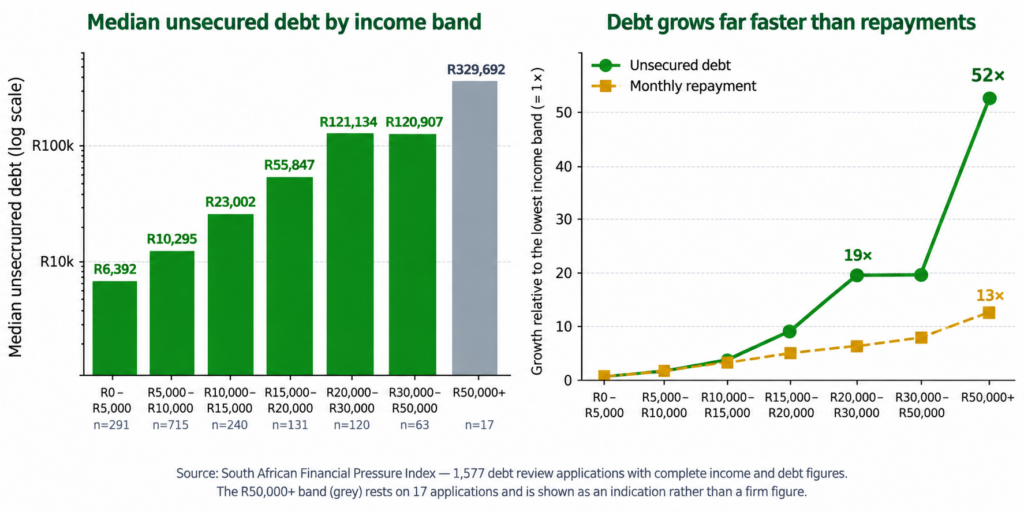
Unsecured debt and monthly repayments across income bands, South African Financial Pressure Index.
| Net monthly income | Applications | Median unsecured debt | Median monthly repayment |
| R0 – R5,000 | 291 | R6,392 | R2,015 |
| R5,000 – R10,000 | 715 | R10,295 | R3,607 |
| R10,000 – R15,000 | 240 | R23,002 | R6,954 |
| R15,000 – R20,000 | 131 | R55,847 | R10,832 |
| R20,000 – R30,000 | 120 | R121,134 | R12,227 |
| R30,000 – R50,000 | 63 | R120,907 | R15,903 |
| R50,000+ | 17 | R329,692 | R26,940 |
Read down the debt column. Someone earning between R5,000 and R10,000 carries a median R10,295 in unsecured debt, roughly one and a half times a month’s income. Someone earning between R20,000 and R30,000 carries R121,134, closer to five times.
The debt does not rise in step with income. It rises faster.
A caution on the last row: it rests on 17 applications. That is too thin to treat as a firm figure, and I include it with the sample size visible rather than leaving it out, because the shape of the pattern matters even where a single row is provisional. The R20,000 to R30,000 band, with 120 applications behind it, tells the same story on much firmer ground.
Why the pattern exists
Credit is granted against earnings. That is the whole mechanism, and it is not a scandal, it is how affordability assessment is designed to work under the National Credit Act.
The consequence is that a higher salary buys a higher debt ceiling. A person earning R25,000 qualifies for a larger personal loan, a bigger credit card limit and a longer vehicle finance term than a person earning R8,000. Each individual decision passes its affordability test at the moment it is made. Nobody in the chain sees the full picture, because no single credit provider is looking at the whole balance sheet, and the consumer is usually the last to add it up.
Composition matters here too. Across 7,393 unsecured accounts in the same dataset, personal loans account for 59.2% of accounts and 61.7% of the total balance, R61.4 million of R99.6 million. Credit cards are second, at 24.6% of balance from only 14.5% of accounts. Store cards are common but small: 12.9% of accounts, 5.6% of balance.
That is worth sitting with. The debt that pushes higher earners into difficulty is not accumulated in small amounts at clothing retailers. It arrives in large instruments, granted on the strength of a good payslip.
Over-indebtedness is a ratio, not an income bracket
Section 79 of the National Credit Act defines over-indebtedness by reference to whether a consumer can satisfy their obligations in a timely manner, judged against their financial means and obligations. It says nothing about earning a particular amount.
This is the part that gets lost. A consumer earning R40,000 who is servicing R38,000 in monthly commitments is over-indebted. A consumer earning R7,000 with R2,000 in commitments is not. The salary is not the test. The ratio is.
Across all applicants in the index, the median share of net monthly income going to unsecured debt repayments alone is 57.8%, before any bond or vehicle finance. More than half of applicants, 54.9%, are above 50%.
What stops higher earners from asking
Three things, in my experience of assessing these applications.
The first is identity. Debt review is understood as a poverty intervention, so people who do not consider themselves poor rule it out before they look at what it is. They are not weighing the option and rejecting it. They never get as far as weighing it.
The second is the belief that the problem is temporary. Higher earners have more room to move money around, and that room disguises the trend. A bonus covers a shortfall. A new facility rolls an old one. Each fix is real and each one buys time, which is exactly why the underlying ratio can deteriorate for years without a moment that forces the issue.
The third is professional exposure. People in regulated roles, or in positions where a credit check forms part of their employment, worry that a debt review flag will cost them their standing. It is a fair thing to ask about, and it deserves a straight answer from a registered debt counsellor rather than a guess, because the answer depends on the specific role and the specific employer.
None of these is a financial reason. All three delay the application, and delay is expensive. A consumer who applies at 40% of income committed to unsecured debt has options that a consumer at 75% no longer has.
What this means for the industry
If a fifth of applicants are earning above R15,000, our consumer education is aimed at the wrong reader.
Most published material on debt review, including a good deal of our own, addresses someone in visible crisis: someone facing repossession, receiving letters of demand, already in default. That reader exists and needs the material. But the earner watching their disposable income shrink each year, who is still paying everything on time, does not see themselves anywhere in that literature. By the time they recognise the description, they have usually lost several years of options.
Two practical changes would help.
The first is language. Describing debt review as a last resort for people who cannot pay is inaccurate and it filters out the people who would benefit most from applying early. The Act frames it around affordability. So should we.
The second is data. The industry publishes very little segmented by income, which makes it easy for the low-income assumption to persist unchallenged. Debt counsellors hold this data. Publishing it, with sample sizes visible and with the thin rows flagged as thin, is within reach of any practice that wants to contribute.
For consumers reading this
If your unsecured debt repayments are consuming a growing share of what you earn, the fact that you earn well is not a reason to wait. It is the reason the problem has been able to grow quietly.
A free assessment with an NCR-registered debt counsellor will tell you your actual ratio and whether you meet the section 79 test. If you do not, you will be told so. If you do, you will have found out while you still have choices.
Check that any counsellor you approach appears on the National Credit Regulator’s register of registrants, and ask for their NCRDC number before you share financial information. DCASA membership is a further layer of accountability on top of NCR registration, not a substitute for it.
Rowan Breeds is a registered debt counsellor (NCRDC2423) at Debt Solutions 4U (www.debtsolutions4u.co.za) and a full member of DCASA. The figures in this article come from the South African Financial Pressure Index, a monthly index published from debt review application and credit bureau data. The underlying figures are available to DCASA and to media on request.
Data source
South African Financial Pressure Index (SAFPI), published monthly by Debt Solutions 4U from debt review application and credit bureau account data. Baseline release August 2026: 1,913 applications, of which 1,577 carry complete income and debt figures; 7,393 unsecured accounts; 524 NCR register checks. Available to DCASA in full on request.