
Understanding DCRS: A Key Tool in Debt Review
June 22, 2026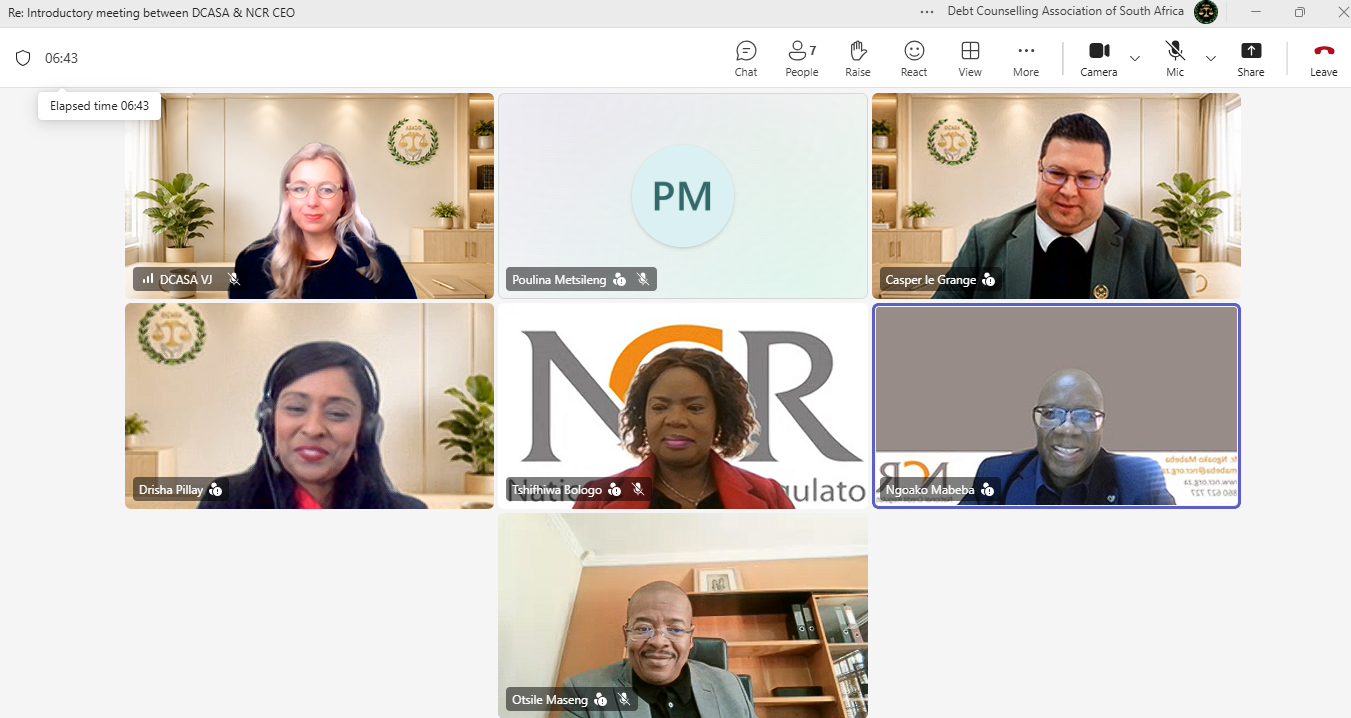
There are moments when polite conversations simply are not enough.
For years, those working in debt review have experienced the daily realities of an industry under immense pressure. Consumers left in limbo. Rogue debt counsellors exploiting vulnerable people. Outdated legislation struggling to keep pace with modern challenges. Credit provider non-compliance. Frustration has been building for a long time.
When DCASA met with the National Credit Regulator’s new leadership, this was never going to be another courtesy meeting where difficult issues were carefully tiptoed around.
Representing the NCR were CEO Mr Otsile Maseng, COO Tshifhiwa Bologo, and Acting Company Secretary Ngoako Madeba. From the outset, it was evident that this meeting would be different. Before discussing policies or directives, the CEO wanted to hear directly from industry stakeholders. He wanted honesty.
And that is exactly what he received.
Our President spoke candidly about the realities facing debt review every single day. Nothing was sugar-coated. Every frustration—from the abuse suffered by consumers to the challenges created by rogue debt counsellors, outdated legislation, outdated debt counsellor fees, weaknesses in systems, and the increasing burden placed on ethical debt counsellors—was laid on the table.
At times, we wondered whether we had crossed the line. It was, after all, our first engagement with the new CEO. But the challenges facing our industry have reached a point where honesty is no longer optional.
Instead of becoming defensive, Mr Maseng simply smiled.
“Thank you. This is exactly what I needed—a robust and honest discussion.”
Those words changed the tone of the meeting.
The CEO openly acknowledged that, before meeting DCASA, he had reservations about who we were and what role we played. He candidly admitted that he questioned whether DCASA existed to protect rogue debt counsellors operating within the industry.
By the end of the discussion, his view had changed.
He recognised that DCASA shares the NCR’s determination to remove rogue operators from debt review and restore confidence in the profession.
That acknowledgement alone made the conversation worthwhile.
One statement, however, stood out above all others.
Mr Maseng explained that while the NCR will continue to regulate the industry and expects compliance with its directives, he wants to understand the practical consequences before decisions are made.
“I will regulate, and I expect you to abide. But I will ask you what the practical implications of my decisions are before I make them.”
He was equally clear that consulting stakeholders does not mean he will always agree with them—but it does mean his decisions will be informed by those who work in the industry every day.
For DCASA, this represents exactly the kind of engagement we have long advocated for.
Our President reiterated that DCASA is not a regulator. That responsibility belongs to the NCR. Our role is different. We provide the practical perspective. We see where the legislation works, where it falls short, where consumers become over-indebted, and where fraudulent conduct begins to emerge. It is this collective industry intelligence that enables us to identify problems long before they become headlines.
One of the most significant discussions centred around the Debt Help System (DHS).
Our President highlighted the vulnerabilities within the current system and how those weaknesses create opportunities for abuse that ultimately affect consumers, debt counsellors, credit providers and the integrity of debt review itself.
The CEO did not hesitate.
He acknowledged that safeguarding the DHS has become an immediate priority.
“The DHS must be protected. We need proper safeguards and a clear audit trail.”
He stressed that this is not something that can wait—it is a priority that requires urgent attention.
For many around the table, this was one of the most reassuring moments of the discussion. Recognising the risks is one thing. Acknowledging that action is needed immediately is another.
The conversation also turned to the future of the profession itself.

Mr Maseng acknowledged that the debt counselling environment has evolved significantly over the years, yet many of the existing training modules have not kept pace with the realities of today’s credit industry.
“Training cannot remain static while the credit industry continues to evolve.”
It was encouraging to hear an appreciation that education and professional development must evolve alongside the industry if consumers are to receive the protection they deserve.
Consumer protection remained the central theme throughout the meeting.
Mr Maseng expressed particular concern about consumers being placed under debt review without their knowledge or proper consent and the serious legal consequences this creates.
He also acknowledged that rogue debt counsellors do not only damage the reputation of the profession—they damage the credibility of the NCR itself.
He asked whether DCASA would work alongside the Regulator in addressing these challenges.
Our answer was simple.
Absolutely.
If we genuinely want to restore confidence in debt review, this cannot be achieved by the Regulator or industry associations working in isolation. It requires partnership, transparency and the courage to confront uncomfortable truths together.
The meeting also produced practical outcomes.
COO Tshifhiwa Bologo requested copies of DCASA’s presentations, together with our previous submissions on legislative and regulatory reform that had already been submitted to the Department of Trade, Industry and Competition. An undertaking was also made for ongoing engagement between the NCR’s operational team and DCASA to continue discussions on the practical realities affecting debt review.
Will one meeting solve the challenges facing our industry?
Of course not.
Years of frustration cannot be resolved in a single afternoon.
But every meaningful change begins with a conversation where people are willing to listen—and, just as importantly, willing to speak honestly.
For the first time in a long time, it felt as though the frustrations experienced daily by debt counsellors, consumers and industry stakeholders were not only heard but genuinely understood.
We remain realistic about the work that lies ahead.
There are still difficult conversations to be had. There are still systems to improve. There are still rogue operators to remove. There are still consumers who deserve better.
But we left this meeting with something that has been missing for some time.
Hope.
Not hope based on promises.
Hope based on honest conversation, mutual respect, and a shared commitment to protecting the integrity of debt review.
Perhaps this was more than just another stakeholder meeting.
Perhaps this was the turning point our industry has been waiting for.
-Vanessa Johst – Operations Manager of DCASA 26.6.2025